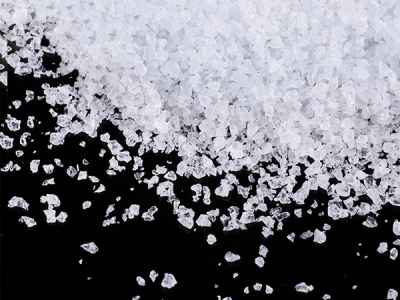
There are three types of ions commonly used in polyacrylamide (PAM): cationic, anionic, and non-ionic. Different ionic forms of polyacrylamide (PAM) have different functions. Due to the wide range of applications of anionic polyacrylamide (HPAM) and cationic polyacrylamide (CPAM), many customers do not know how to distinguish between them, but this is understandable, because no matter what ionic typePolyacrylamide (PAM) is the same white particle in appearance, how to distinguish between anionic (HPAM) type and cationic typePolyacrylamide (CPAM)? What is the difference between cationic (CPAM) and anionic polyacrylamide (HPAM)? The following Henan Laixing Water Purification will answer this question in detail.
Test pH to determine:
Polyacrylamide (PAM) particles are dissolved in water in a certain proportion, and then the pH value of the aqueous solution is determined. Since the pH values of different types of polyacrylamide (PAM) are different, the performance of polyacrylamide (PAM) can be identified by this method. However, due to the different production processes of manufacturers, there will be some deviations, which can also be judged by determining the pH value of the production process.
Judging from the dissolution time:
Since different types of polyacrylamide (PAM) dissolve in water have different dissolution times, they can be judged according to different dissolution times. Dissolution time from short to long: anionic polyacrylamide (HPAM) < nonionic polyacrylamide (NPAM) < cationic polyacrylamide (CPAM) 。 The dissolution time of anionic polyacrylamide (HPAM) is about 30 minutes, and the dissolution time of nonionic polyacrylamide (NPAM) is about 40 minutesCationic polyacrylamide (CPAM).The dissolution time is about 60 minutes. Therefore, the type of polyacrylamide (PAM) can be broadly distinguished from the dissolution time.
Mixed addition method judgment:
Customers who are frequently exposed to polyacrylamide (PAM) may know that anionic polyacrylamide (HPAM) and cationic polyacrylamide (CPAM) cannot be mixed, Because there will be a strong reaction effect when mixed, because the contact of positive and negative charges will form a cotton-like substance, and the aqueous solution of polyacrylamide (PAM) will become cloudy. This method is suitable for known polyacrylamide (PAM) ionic types. Because this method is more accurate, qualified customers can use this method to judge.
According to the sewage reaction:
The type of polyacrylamide (PAM) can be clearly determined by the reaction of different ionic types of polyacrylamide (PAM) with wastewater. Anionic polyacrylamide (HPAM) is generally suitable for wastewater with high suspended solids concentration, positive charge, and neutral or alkaline pH; Cationic polyacrylamide (CPAM) is suitable for negatively charged suspended solids. Nonionic polyacrylamide (NPAM) is suitable for sewage with a neutral pH or wastewater, inorganic and organic mixed suspended solids.
The above four judgment methods can judge the difference between cationic (CPAM) and anionic polyacrylamide (HPAM), as well as different ionic types of polyacrylamide (PAM). The specific model, molecular weight, ionization degree and other detailed information can be mailed to us if the conditions are not sufficient, free laboratory testing.